Conway
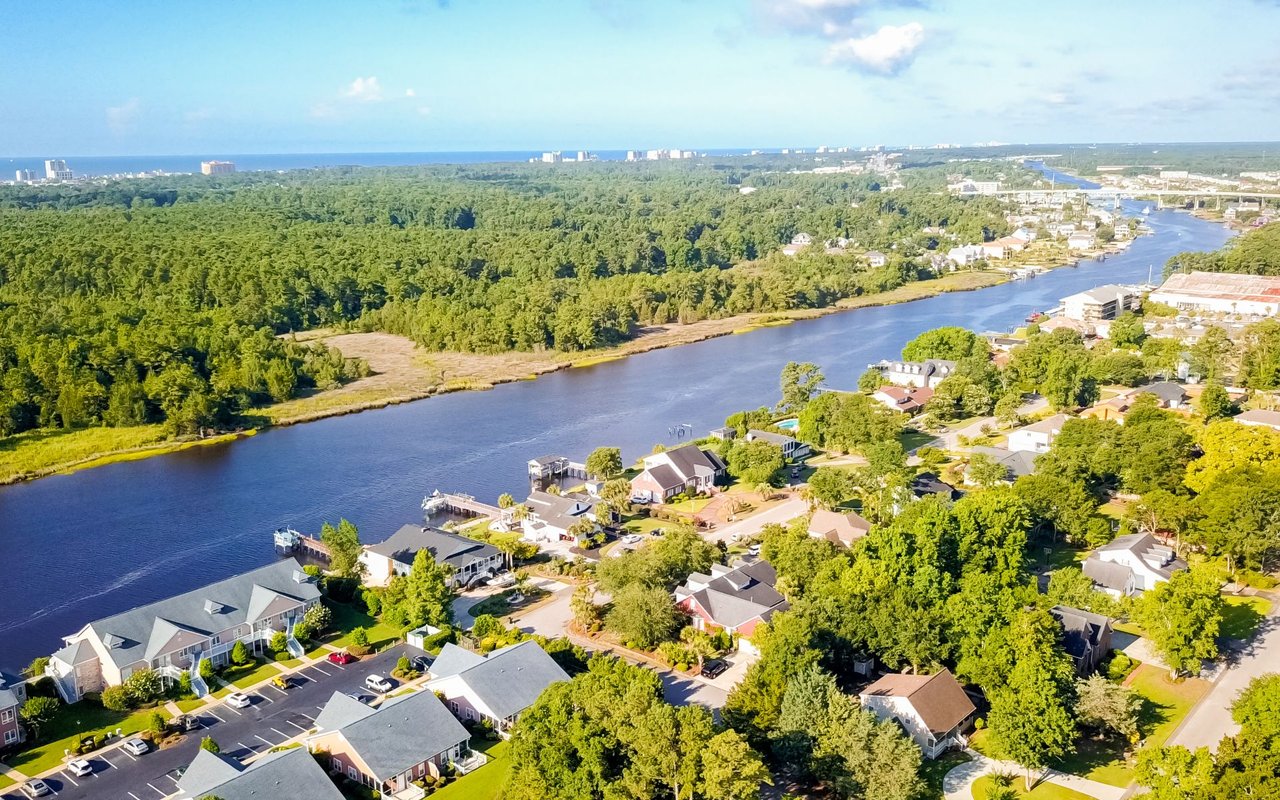
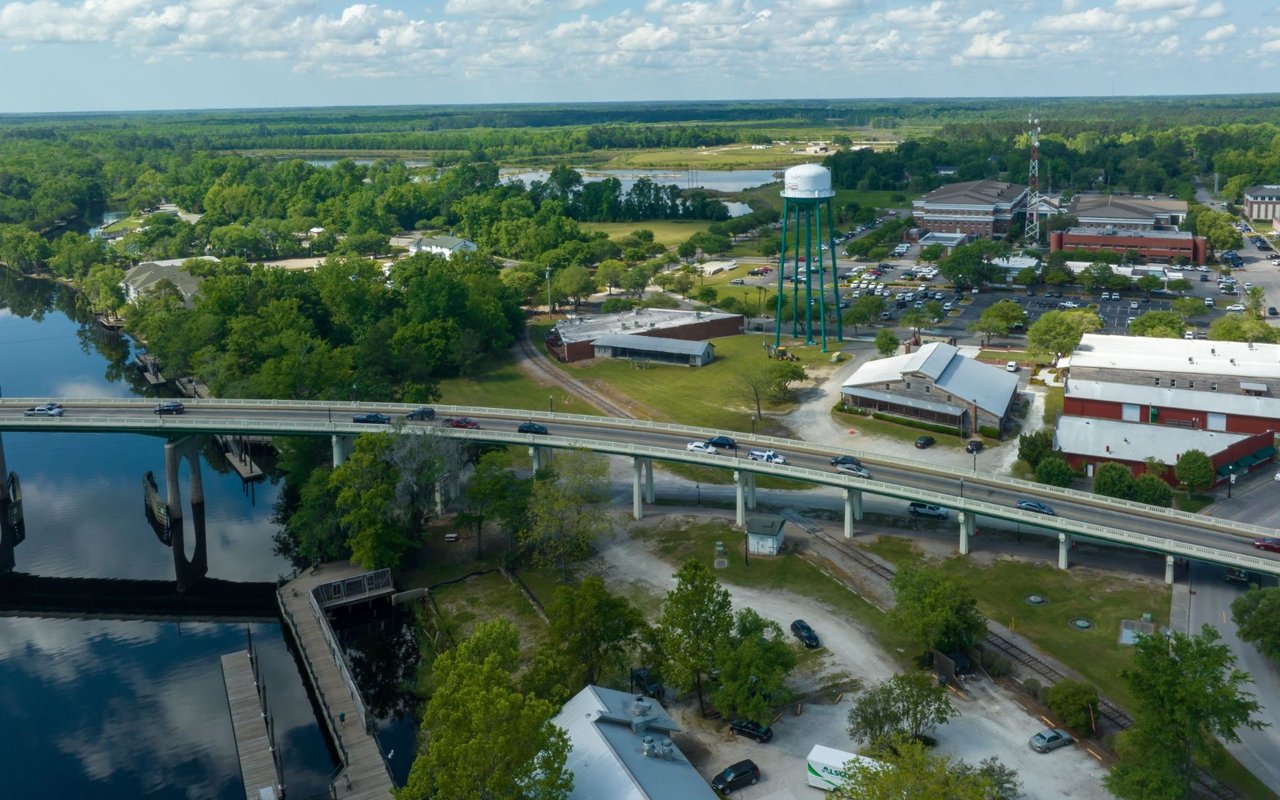
A historic community, founded along the banks of the Waccamaw River.
A historic community, founded along the banks of the Waccamaw River.
80,230 people live in Conway, where the median age is 41.3 and the average individual income is $29,126. Data provided by the U.S. Census Bureau.
Total Population
Median Age
Population Density Population Density This is the number of people per square mile in a neighborhood.
Average individual Income
Conway is not a beach town, and that is precisely the point. As the county seat of Horry County and one of the oldest towns in South Carolina — founded in 1732 as Kingston — Conway runs on a year-round rhythm that has almost nothing in common with the seasonal churn 15 miles east. Streets here are shaded by centuries-old live oaks, the Waccamaw River curls through the middle of town, and the people you see downtown on a Tuesday in February are the same people you'll see there in July.
For most buyers, the first thing that registers is price. Median home sales in Conway sit around $285,000 to $300,000, which is a meaningful discount to anything within walking distance of the Atlantic. That gap is what brings first-time buyers, retirees on fixed incomes, and relocating families to Conway in the first place.
But there are four things every buyer should understand before writing an offer here.
Flood risk is a real underwriting question, not a formality. Conway sits in the Waccamaw River basin, and low-lying sections — particularly older riverfront pockets — have flooded during major storm events and prolonged upstream rain. Request a flood elevation certificate during due diligence, verify the FEMA zone in writing (Zone X unshaded is the goal), and budget for a flood policy even when your lender doesn't require one.
Highway 501 will shape your daily life. US-501 runs straight through Conway and doubles as the main artery carrying beach traffic and commuters into Myrtle Beach. Summer weekends and weekday mornings get genuinely congested. Locals learn SC-22 and Highway 90 early, and buyers should test-drive their likely commute at the actual hour they'd be driving it.
HOA covenants vary sharply by community. The newer master-planned developments — Bridgewater, Hunters Creek, Heritage Preserve — carry covenants governing detached sheds, exterior paint, fencing, and vehicle parking. Historic downtown properties typically have no subdivision HOA at all, but may fall under a historic overlay with its own approval process. These are opposite regulatory environments, and the difference matters more than most buyers expect.
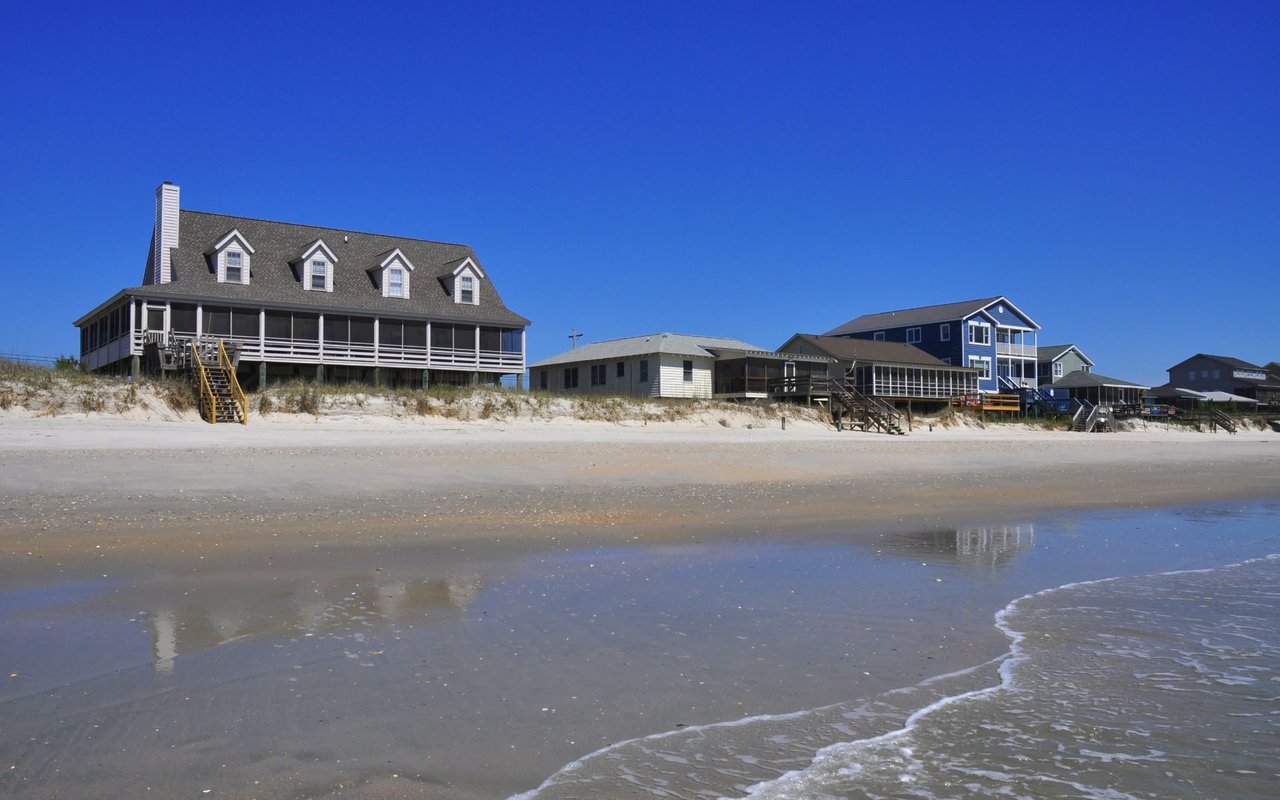
Conway is inland by choice. You trade oceanfront proximity for lower insurance exposure, fewer transient vacation rentals, and a community that doesn't empty out after Labor Day.
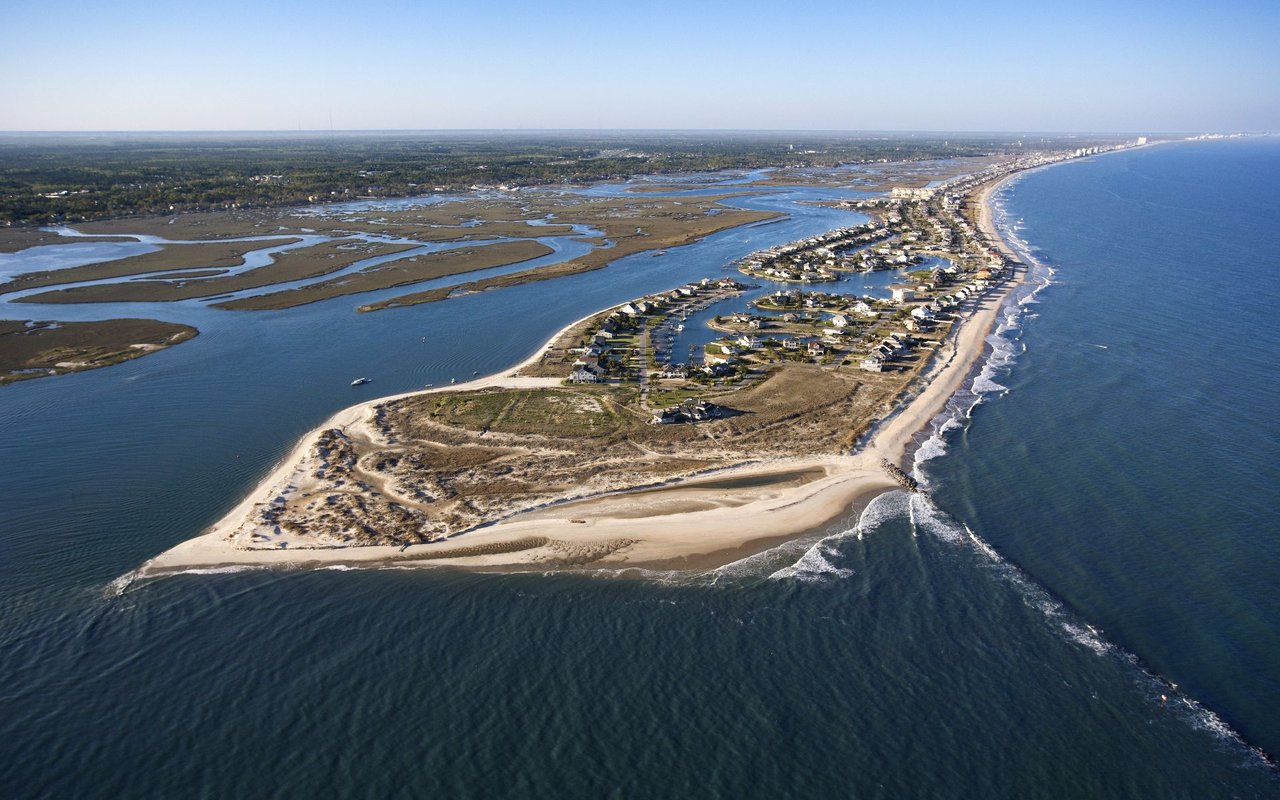
Conway functions as the historic inland anchor of the Grand Strand — roughly 15 miles west of Myrtle Beach, positioned where the region's major highways converge rather than where they dead-end at the ocean.
From Conway, you're about 20 to 30 minutes from the Myrtle Beach oceanfront via US-501, 25 to 35 minutes from North Myrtle Beach via SC-22 or Highway 90, and 35 to 45 minutes from Murrells Inlet and the South Strand via SC-544 and US-701.
That geography produces what long-time residents call the buffer effect. You get genuine beach access on a weekend-afternoon timeframe while sitting outside the coastal insurance zone, the tourist congestion, and the short-term rental density that defines oceanfront neighborhoods. Your house is a house, not a revenue property surrounded by other revenue properties.
The connectivity is also better than it looks on a map. SC-22 bypasses the worst of the beach corridor entirely on the run north. US-501 gets you to central Myrtle Beach directly. US-701 and SC-544 handle south and west movement. Compare that to coastal neighborhoods that funnel everything onto Kings Highway, and Conway's regional access is arguably stronger despite being farther from the sand.
What keeps Conway from being a bedroom community is that it has its own economic base. Coastal Carolina University, Horry-Georgetown Technical College, and the expanded Conway Medical Center campus mean a substantial share of residents work, get treated, and educate their kids without ever crossing into Myrtle Beach.
Conway is a balanced-to-warm market. Inventory moves, but not at the pace where buyers are forced to waive inspections — which is a meaningful advantage in a town with as much older housing stock as this one.
Metric | Current Value | What It Means for You |
|---|---|---|
Median Sale Price | ~$287,000 | Substantially below coastal Horry County zip codes |
Median List Price | ~$316,000–$323,000 | The gap reflects new construction premiums in the listing pool |
Sale-to-List Ratio | 98.1% | Buyers typically close 1–2% under asking |
Days on Market | 67–86 days | Room to inspect, negotiate, and walk away if needed |
Dominant Property Types | Single-family and townhomes | Split between historic homes and master-planned subdivisions |
Two forces drive this market. The first is new construction along the SC-90, SC-544, and US-701 corridors, where builders have added most of the recent single-family supply and where the list-price median gets pulled upward. The second is Coastal Carolina University, which generates steady, predictable demand for starter homes and single-family rentals — demand that doesn't evaporate when the tourist season ends.
The practical takeaway: a buyer in Conway has negotiating room that a buyer in Market Common or Carolina Forest often does not. That sale-to-list ratio and the two-to-three-month days-on-market figure are not distress signals. They're a functioning market where due diligence is still possible.
Downtown Conway is the reason a lot of buyers stop looking anywhere else. Brick storefronts, live oaks heavy with Spanish moss, and the dark tannin-stained water of the Waccamaw moving slowly past the end of Main Street.
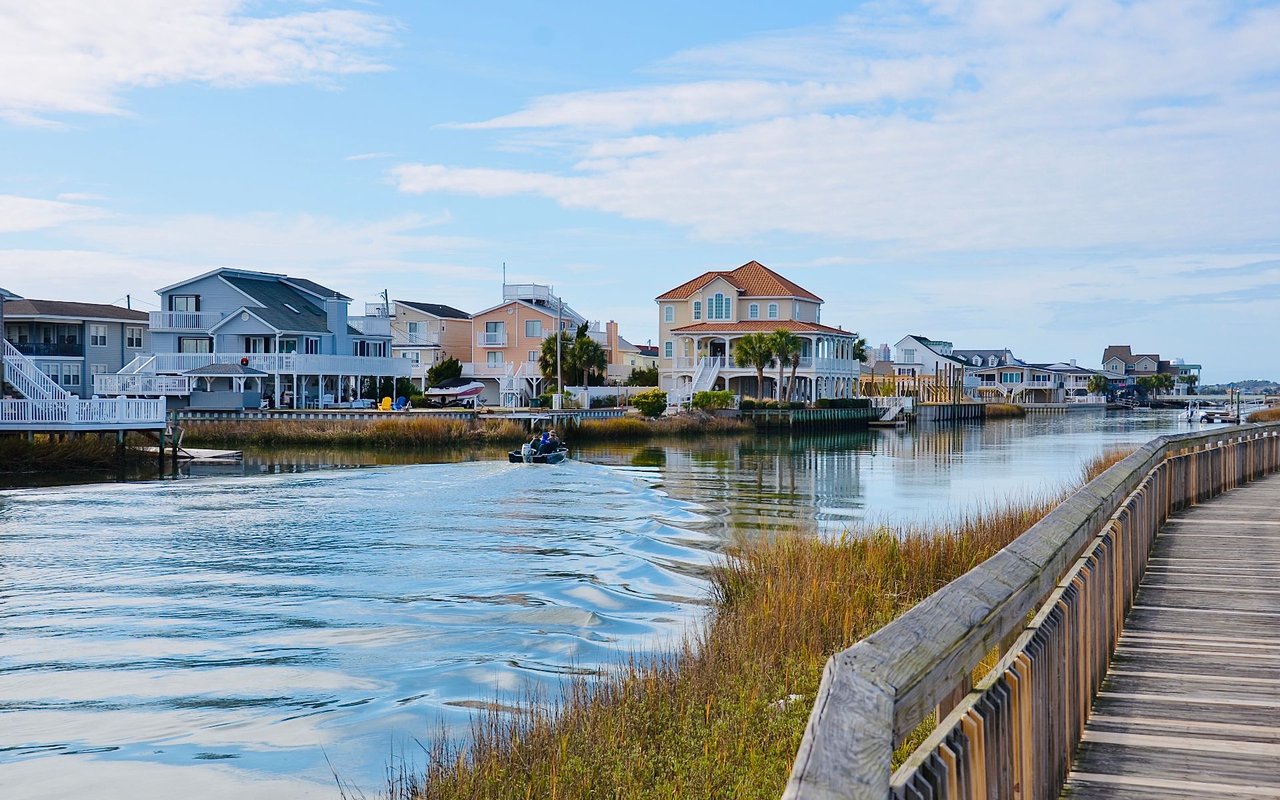
The centerpiece is the Riverwalk, a 1.5-mile boardwalk and paved trail along the river. It connects Riverfront Park, the public boat launch at Conway City Marina, a ship-themed playground, and an arboretum planted with native species. It functions as the town's shared backyard — morning walkers, kids after school, boaters loading up on Saturday.
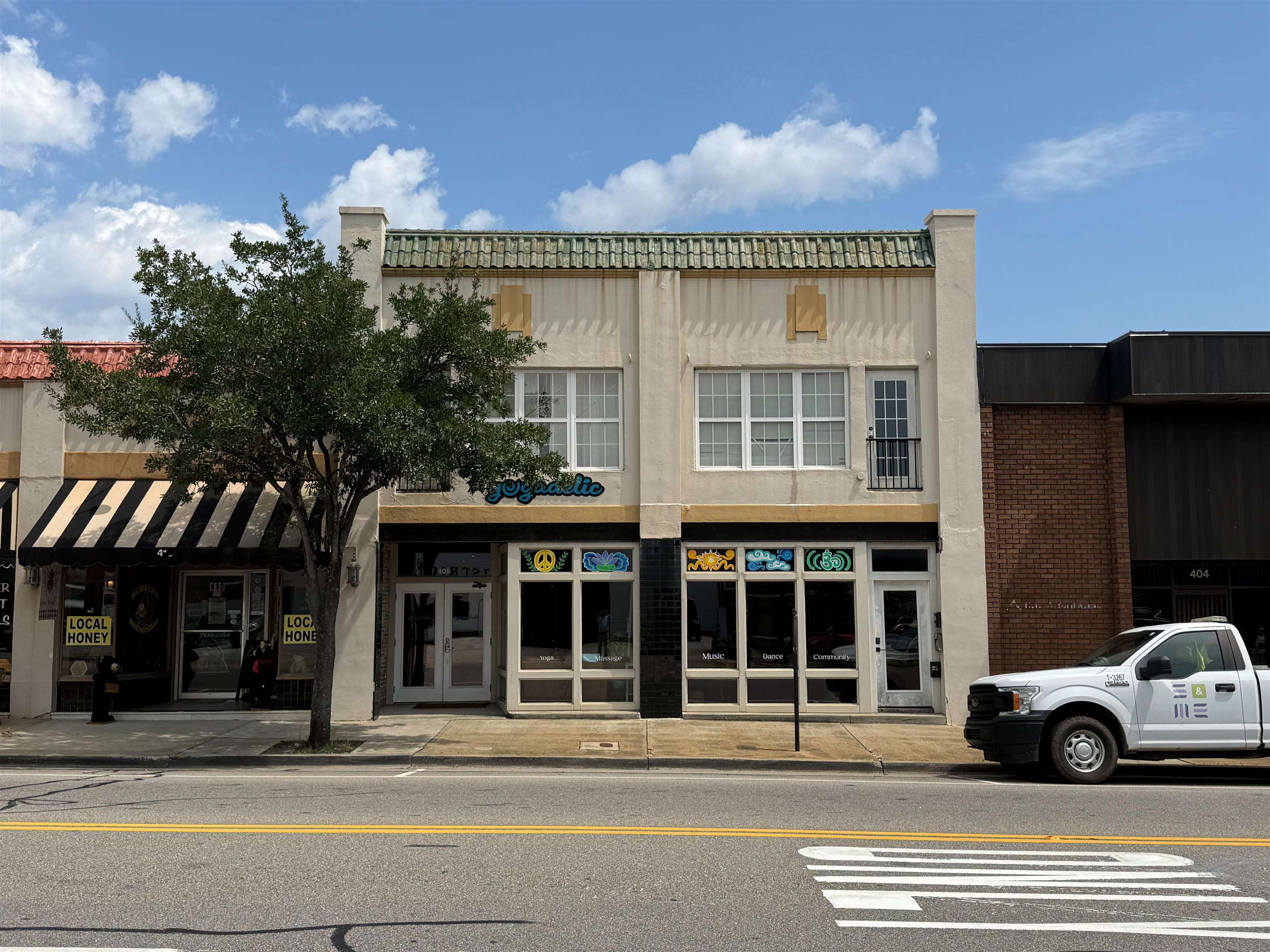
The commercial core runs along Main Street and Laurel Street, where 19th-century buildings listed on the National Register house independent boutiques, antique dealers, booksellers, and local restaurants. Bonfire Taqueria sits right on the water. This is a downtown that people actually use, not a preserved streetscape.
The event calendar reinforces that. Riverfest, downtown Halloween festivities, and the Christmas Boat Parade on the Waccamaw are annual anchors that draw the whole city, and they're a large part of why residents describe Conway as a place with a civic identity rather than a subdivision address.
For buyers, proximity to this district carries a real premium — and a real trade-off, since the closest homes to the river are also the ones with the most flood-zone scrutiny.
Conway holds three listings on the National Register of Historic Places: the Conway Residential Historic District, the Conway Commercial Historic District, and the Waccamaw River Skirmish Site.
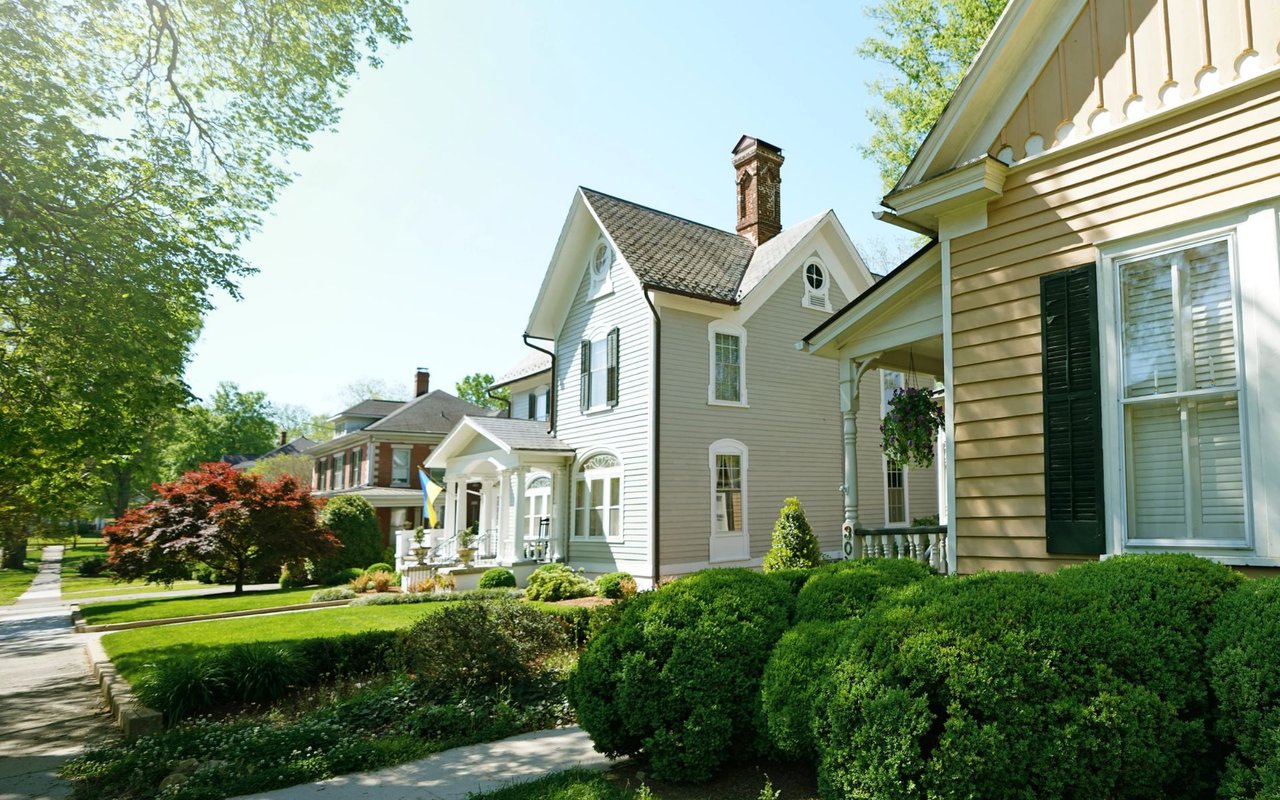
A catastrophic fire in the late 19th century destroyed much of the commercial core, which is why downtown reads as early-20th-century brick rather than antebellum. The residential streets are where the older architecture survives, and they offer a genuine mix:
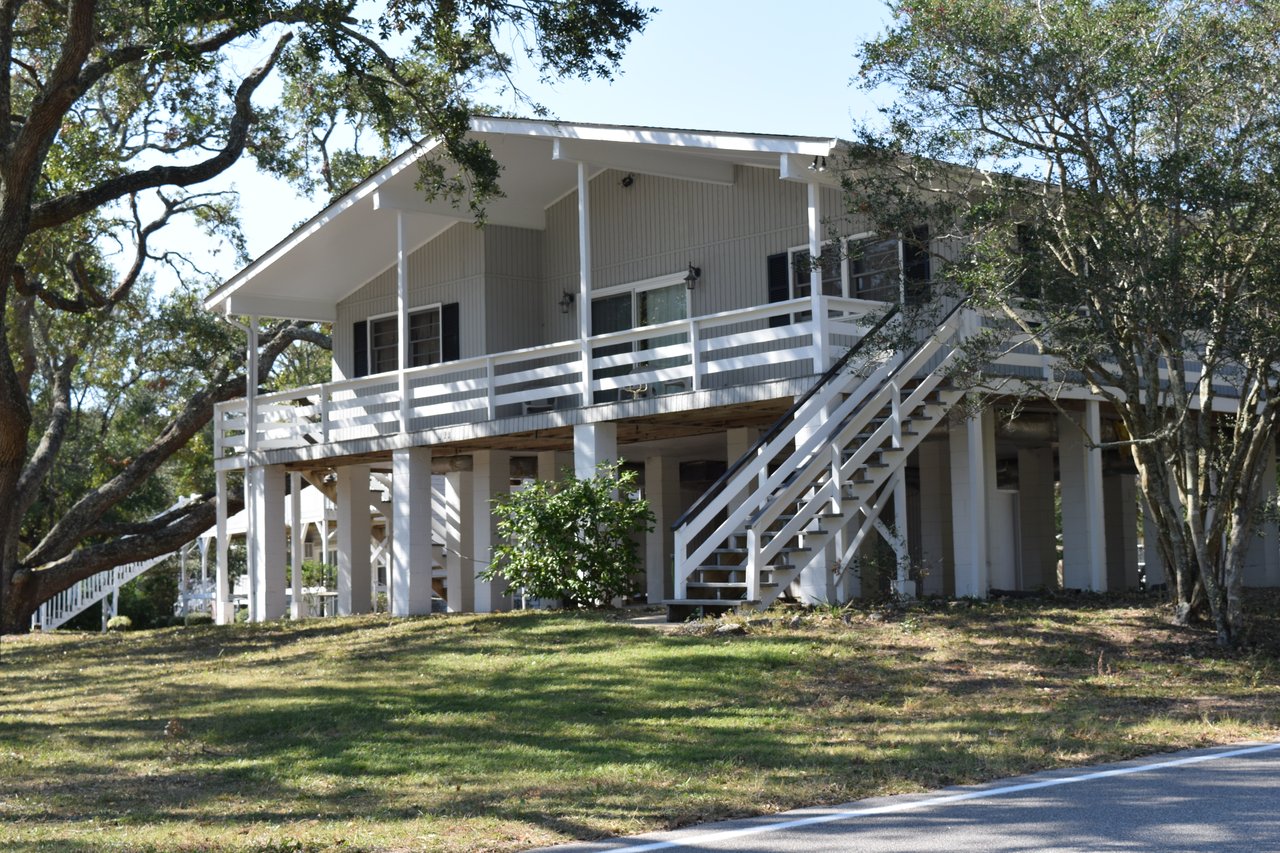
Antebellum and Greek Revival homes feature deep entry porches, prominent columns, and a symmetry that was engineered to pull river air through the house before air conditioning existed. Victorian and Queen Anne properties bring intricate millwork, wrap-around porches, and asymmetrical rooflines. Lowcountry cottages sit on raised foundations built specifically to handle a high water table and heavy rain — a design decision that still pays off.
One landmark worth knowing: Conway City Hall on Main Street was designed by Robert Mills, the federal architect behind the Washington Monument. That is not a detail most towns of this size can claim.
The regulatory piece matters if you're buying inside a district. Exterior alterations, structural additions, color palettes, and fence installations require approval from the Conway Community Appearance Board (CAB). This is not a rubber stamp. Buyers planning renovations should price in both the timeline and the possibility of a "no" before they close, not after.
This is the single most misunderstood rule in Conway real estate, and it catches out-of-state buyers constantly.
Conway protects its live oak canopy through a Tree Preservation Ordinance, and the protection attaches to the tree, not to the owner's preference. Any live oak measuring 24 inches or more in diameter at breast height — 4.5 feet above ground — is classified as a protected landmark tree.
What that means in practice:
You cannot remove, heavily trim, or top a protected live oak without a permit from the City of Conway Planning & Development Department. The permit itself is free. Getting it approved is the hard part.
Removal is generally approved only on arborist findings — that the tree is dead, severely diseased, structurally unsound, or presents a direct threat to a primary residential structure. "It drops leaves on my driveway" and "I want a pool there" are not qualifying conditions. Removing a protected oak without a permit results in significant financial penalties plus mandatory replacement plantings.
Root zones are protected too. Routine limbing-up for clearance is fine. Aggressive pruning or severing major structural roots inside the canopy dripline is restricted, and any construction inside a protected tree's root zone requires physical barrier fencing during the build.
Before you buy a lot with a mature oak on it and a plan that involves that oak not being there, have that conversation with the city first. It's a fifteen-minute call that has saved buyers from six-figure mistakes.
Conway's residential market splits into distinct sub-markets that behave differently on price, appreciation, and lifestyle.
Neighborhood | Property Types | Median Price Range | Core Appeal |
|---|---|---|---|
Historic Downtown Core | Historic single-family (Craftsman, Victorian, Lowcountry) | $320,000–$550,000+ | Walkable to Riverwalk and Main Street, mature live oaks, no subdivision HOA |
Wild Wing Plantation | Custom and luxury golf homes | $450,000–$700,000+ | Gated golf community, waterfront lots, resort pool, clubhouse, boat slips |
Bridgewater | New construction single-family and villas | $310,000–$440,000 | Active-lifestyle amenities — fitness center, resort pool, dog park, trails |
Heritage Preserve | Single-family, built 2018–present | $300,000–$390,000 | Family-oriented, open floor plans, community pool, low HOA dues |
Midtown Village | Townhomes and starter single-family | $220,000–$290,000 | Low-maintenance living near US-501 and CCU; strong rental demand |
A note on how to read this table: the price ranges are less important than the trade-off each community represents. Downtown buys you character and freedom from covenants at the cost of maintenance and flood scrutiny. Wild Wing buys amenities and a gate. Bridgewater and Heritage Preserve buy warranty coverage and efficiency at the cost of monthly dues and small lots. Midtown Village buys the lowest entry point in the city and the strongest rental liquidity.
Nowhere else on the Grand Strand is this decision as sharply defined as it is in Conway, because the two options are genuinely different products.
Historic homes (pre-1970s) give you architectural detail that cannot be replicated at any price — high ceilings, original heart-pine floors, deep porches, and lots large enough to hold century-old trees. Downtown properties operate without master-planned HOA fees or restrictive covenants, which for some buyers is the whole argument. The costs are real, though: aging HVAC, roofs, and plumbing; lower baseline energy efficiency; elevated flood exposure near the river; and if you're inside a historic overlay, CAB approval standing between you and any exterior change.
New construction communities are built to current South Carolina energy codes — spray foam insulation, high-efficiency HVAC, impact-resistant roofing — and come with one-to-ten-year builder warranties that keep short-term repair capital near zero. The offsets are a higher price per square foot, monthly HOA dues, smaller lots, minimal mature canopy for the first decade or two, and covenants governing what you can do to the outside of your own house.
The honest framing: historic homes cost more over time and reward owners who want a project and a piece of the town's history. New construction costs more up front and rewards owners who want predictability. Neither is the better buy in the abstract — it depends entirely on your maintenance appetite and your five-year plan.
Conway's flooding is riverine, not coastal, and that distinction changes how you evaluate risk. Water here rises slowly, often days after a tropical system, and often from rain that fell upstream in North Carolina rather than locally. That means a Conway property can flood on a day the sun is out.
Flood Zone | Risk Level | Lender Requirement | Insurance Impact |
|---|---|---|---|
Zone X (Unshaded) | Minimal | Optional | Lowest rates; preferred-risk policies available |
Zone X (Shaded) | Moderate (500-year) | Usually optional | Low-to-moderate; strongly recommended anyway |
Zone AE / A | High (100-year) | Mandatory with a mortgage | Varies significantly with elevation relative to BFE |
Three things drive your actual premium:
Base Flood Elevation. In Zone AE, the number that matters is how high the lowest finished floor sits relative to BFE. A home built well above BFE can pay a fraction of what a comparable home at or below BFE pays.
The Elevation Certificate. Order one during due diligence on any property near the river, near low-lying creeks, or anywhere close to a Zone AE boundary. Do not rely on a zone designation alone — boundaries are drawn at a scale that doesn't capture individual lots well.
NFIP Risk Rating 2.0. Flood pricing is now property-specific: distance to water, foundation type, and exact elevation, rather than broad zone categories. Two houses on the same street can price very differently. Get an actual quote before your contingency expires, not an estimate.
With enrollment above 10,000 students plus faculty and staff, CCU is the largest single force shaping Conway's housing market — and its effect is neighborhood-specific.
Rental demand concentrates near campus. Areas along SC-544, University Forest, and College Park sustain steady demand for single-family rentals and multi-tenant housing. For investors, that's a durable income base. For owner-occupants, it means checking who your neighbors actually are.
Appreciation follows proximity. Homes within a five-to-ten-minute radius of campus tend to hold strong resale liquidity because there is always a buyer pool — faculty, staff, parents buying for students, or investors.
Traffic is seasonal in a way that mirrors the beach. During spring and fall semesters, US-501 and SC-544 tighten up around morning class times, and Brooks Stadium game days add their own pattern. Summer, oddly, is the quiet season in the campus corridor even as it's the busy season everywhere else on the Strand.
Owner-occupants should read HOA rental restrictions carefully. If a long-term quiet street is what you're after, some near-campus subdivisions cap rentals and some don't. That single covenant provision will define your experience of the neighborhood more than any amenity.
Conway is served by Horry County Schools, a countywide district. Because the Conway area covers a large geographic footprint, school assignment is determined at the address level — two homes a few minutes apart can feed different schools. Always verify zoning against the specific property address before you fall in love with a house for school reasons.
Elementary (PK–5): Conway Elementary and South Conway Elementary serve central and southern Conway neighborhoods. Pee Dee Elementary and Homewood Elementary cover the western and northern suburban and rural corridors. Waccamaw Elementary serves the fast-growing east Conway zones near Highway 90.
Middle (6–8): Conway Middle School, Whittemore Park Middle School, and Black Water Middle School.
High (9–12): Conway High School — home of the Tigers — anchors the primary high school zone.
Specialized options: Conway hosts two countywide programs on or near the CCU campus — HCS Scholars Academy and HCS Early College High School. Both are magnet/early-college pathways drawing students from across Horry County, and their presence in Conway is a genuine advantage for families with academically driven students.
South Carolina offers some of the lowest effective property taxes in the country for primary residents — and some of the sharpest penalties for everyone else. Understanding which side of that line you're on is the difference between a $1,300 tax bill and a $3,800 one on the same house.
4% Assessment Ratio | 6% Assessment Ratio | |
|---|---|---|
Applies To | Primary owner-occupied residence | Second home, vacation home, or rental |
School Operating Tax | Exempt under SC Act 388 | Applied in full |
Est. Annual Tax, $300K Home | ~$1,200–$1,500 | ~$3,400–$4,200 |
Here is what trips up nearly every out-of-state buyer: the 4% rate is not automatic. Horry County defaults your assessment to 6% at closing and leaves it there until you act.
To claim it, you file a Legal Residence Application with the Horry County Assessor. You'll need a South Carolina driver's license and South Carolina vehicle registration, both matching your new Conway address — which means the DMV visit is part of the process, not optional paperwork you can defer.
File as soon as you close, and no later than January 15 of the year following purchase. Miss it and you receive a tax bill calculated at 6%, and correcting it after the fact is considerably more work than filing on time.
One of Conway's quieter advantages is that you don't have to drive to Myrtle Beach for ordinary life.
Healthcare is anchored by Conway Medical Center, a regional system with a 220+ bed hospital on Singleton Ridge Road, including an emergency department, critical care unit, surgical center, and specialty clinics. Additional outpatient facilities, urgent care, and primary care practices cluster along US-501 and SC-544. For retirees and anyone managing ongoing care, having a full-service hospital ten minutes away rather than thirty is a material quality-of-life factor.
Groceries and daily needs are covered by Publix, Kroger, Food Lion, and a Walmart Supercenter. Seasonally, the Conway Farmers Market sets up under the Main Street bridge on Saturdays.
Retail splits into two distinct experiences. The downtown historic corridor along Main and Laurel offers independent boutiques, antique shops, booksellers, and local restaurants. The suburban strip along US-501 — including Coastal Centre and Bay Village — handles national retail, Lowe's and Home Depot, discount department stores, and auto services. Most residents use both, for different reasons.
After enough transactions in this market, patterns emerge. Some buyers thrive in Conway. Others regret the purchase within a year. Being honest about which group you're in is worth more than any listing search.
Conway fits you well if you are:
A first-time or budget-conscious buyer trying to maximize square footage and stay under $350,000 on a primary residence without giving up regional job access.
A permanent South Carolina resident who will file for the 4% legal residence ratio — the annual savings compound into a genuinely different cost of ownership over a decade.
An employee of CCU, Horry-Georgetown Tech, or Conway Medical Center looking at a five-to-fifteen-minute commute instead of a seasonal crawl down 501.
A relocator who wants a town, not a resort — brick-paved streets, civic events, blackwater river access, and live oaks over high-rise condos and tourist corridors.
Conway rewards buyers who ask the right questions early — about elevation certificates, live oak permits, CAB approvals, HOA rental caps, and the legal residence filing deadline. Those are the details that don't show up in a listing photo, and they're the ones that determine whether a purchase here works out.
Jan and Dan Sitter of Coastal Beach Homes LLC are licensed South Carolina REALTORS® who work the Grand Strand market daily, including Conway's historic core, its river-adjacent streets, and its newer corridors along SC-90, SC-544, and US-701. They handle every aspect of a transaction personally and stay in direct contact throughout, whether you're buying a first home, selling a property you've owned for thirty years, or relocating from out of state and trying to understand a market from a thousand miles away.
If you'd like a straight answer about a specific street, a specific flood zone, or whether Conway is the right fit at all, reach out.
Coastal Beach Homes LLC — Jan & Dan Sitter
Phone: (854) 269-1593
Email: [email protected]
Office: 9628 N Kings Hwy, Myrtle Beach, SC 29572
Web: coastalbeachhomessc.com
There's plenty to do around Conway, including shopping, dining, nightlife, parks, and more. Data provided by Walk Score and Yelp.
Explore popular things to do in the area, including Happy Customer, Big Daddy’s Grill & Chill, and We Cater to You.
| Name | Category | Distance | Reviews |
Ratings by
Yelp
|
|---|---|---|---|---|
| Dining | 0.18 miles | 0 reviews | 0/5 stars | |
| Dining | 0.38 miles | 0 reviews | 0/5 stars | |
| Dining | 0.38 miles | 0 reviews | 0/5 stars | |
| Dining | 0.38 miles | 0 reviews | 0/5 stars | |
| Dining | 0.45 miles | 0 reviews | 0/5 stars | |
| Dining | 0.46 miles | 0 reviews | 0/5 stars | |
| Dining | 0.5 miles | 0 reviews | 0/5 stars | |
| Dining | 0.5 miles | 0 reviews | 0/5 stars | |
| Active | 0.18 miles | 0 reviews | 0/5 stars | |
| Active | 0.38 miles | 0 reviews | 0/5 stars | |
| Active | 0.41 miles | 0 reviews | 0/5 stars | |
| Active | 0.47 miles | 0 reviews | 0/5 stars | |
| Nightlife | 0.47 miles | 0 reviews | 0/5 stars | |
| Beauty | 0.38 miles | 0 reviews | 0/5 stars | |
| Beauty | 0.38 miles | 0 reviews | 0/5 stars | |
| Beauty | 0.38 miles | 7 reviews | 3.4/5 stars | |
| Beauty | 0.38 miles | 0 reviews | 0/5 stars | |
| Beauty | 0.38 miles | 0 reviews | 0/5 stars | |
| Beauty | 0.38 miles | 0 reviews | 0/5 stars | |
| Beauty | 0.48 miles | 26 reviews | 3.5/5 stars | |
| Beauty | 0.51 miles | 0 reviews | 0/5 stars | |
| Beauty | 0.52 miles | 1 review | 5/5 stars | |
| Beauty | 0.52 miles | 0 reviews | 0/5 stars | |
| Beauty | 0.52 miles | 0 reviews | 0/5 stars | |
|
|
||||
|
|
||||
|
|
||||
|
|
||||
|
|
||||
|
|
Conway has 28,433 households, with an average household size of 2.675. Data provided by the U.S. Census Bureau. Here’s what the people living in Conway do for work — and how long it takes them to get there. Data provided by the U.S. Census Bureau. 80,230 people call Conway home. The population density is 254 and the largest age group is Data provided by the U.S. Census Bureau.
Total Population
Population Density Population Density This is the number of people per square mile in a neighborhood.
Median Age
Men vs Women
Population by Age Group
0-9 Years
10-17 Years
18-24 Years
25-64 Years
65-74 Years
75+ Years
Education Level
Total Households
Average Household Size
Average individual Income
Households with Children
With Children:
Without Children:
Marital Status
Blue vs White Collar Workers
Blue Collar:
White Collar:
When you hire Jan and Dan, you get a team of professional real estate agent diligently working together on your behalf. They are knowledgeable and experienced professionals you can trust to best represent your interests in our unique market.

JAN AND DAN SITTER | COASTAL BEACH HOMES
ADDRESS
9628 N KINGS HWY
MYRTLE BEACH SC 29572